Monday, June 23, 2014

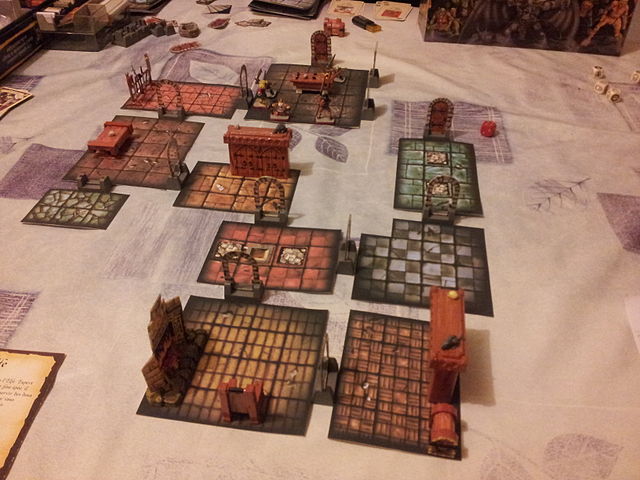
Advanced Hero War Dwarf King's Quest

by Kevain25460 via Wikimedia Commons
HeroQuest was ace, but is out of print. Advanced HeroQuest was ace, but is out of print. Warhammer Quest was ace, but is out of print.

For a while now Mantic has been playing Games Workshop at its own, er, game by releasing the sort of products that GW did before Warhammer took over everything. As well as two wargames, Mantic has also done its own broad analogues of Blood Bowl, Necromunda, and Space Hulk, so it is perhaps no surprise that the company has just announced Dwarf King's Quest:
We always intended to do the typical adventurers’ party version, and Jake has always been very keen on putting his mark on this type of game. However, at the time we just didn’t have the resources, or in some cases the knowhow (such as one-piece miniatures with great detail) to deliver the vision that we had for this type of game. However, with the passing of time all that has changed… :)

Secondly, there are certainly a few great dungeon games out there, but they are all quite different from what we want to make. There are a couple from the light-hearted end of the spectrum – such as Super Dungeon Explore - and others that are intense and deep, such as Descent. But none of those are really in exactly the space we want to occupy.

We want to do a grave and dangerous dungeon miniatures game, set in our fantasy setting, with all the opportunity that gives us to develop the back story and flesh out the world. It will have very strong narrative, based around the main protagonists. This will really bring to life a whole new story arc in the world and highlight some of the big characters for further development. It will also give us a few great sculpts and some heroes for Kings of War armies too.
Mantic has a lot to prove by taking on not only the classics of the genre but also the well-regarded newcomers. I've been impressed by Mantic's output in the past so I'm intrigued, bordering on excited, by this news. Fire of wrath!


Sunday, June 22, 2014

Highrock, Prison in the Sky

Here is a pdf of my game notes for the flying prison of Highrock; it's written for 13th Age because that's what I've been playing for the past few weeks but the notes are light on mechanics and should be easy to convert to other game systems. In my game the player-characters went there to break out the notorious pirate Captain Morgan -- oh dear -- so that she could help them find a mysterious island to the east, where it was rumoured that a great treasure was hidden.

Through his connection to the Prince of Shadows Sartheen the Red knew that one of the wizard-judges of the city of Horizon was involved in some dubious activity involving an orphanage run by vampires -- that's player-driven storytelling in action! -- and so the party blackmailed said wizard into giving them the amulet they required to access the floating island and bypass the guards upon it.

They didn't explore much of the complex, in part because 13th Age doesn't reward exploration in the same way that older editions of D&D do, in part because they were focussed on the mission, and in part because they got beaten up by a squad of flying robots on the second level and wanted to get away as soon as they could. The latter was the result of robot sorcerer Ne-0n's attempt to interface with the island's local code -- he perceives reality as strings of data and can manipulate that data to a certain extent -- going a little wrong and alerting the guards instead of providing the location of Morgan's cell. Oops.

They also had some trouble with the Archmage's quarters, blundering into the fireball trap over and over again, but were rewarded with a fair bit of loot once they staggered past, all blackened and blasted like Warner Brothers cartoon characters; most of the players converted their relationship dice results into items at this point and as a result the Archmage's study held a plethora of magical stuff.

Morgan was freed and the party also let prisoner #666 -- the demon Zeddas -- free while binding him to Amras the elf wizard's service. Or so they think, anyway. They decided not to explore the third level, having been warned by the wizard-judge that death awaited them, and jumped on their waiting air taxi -- another relationship die traded in -- for a quick escape. With their navigator secured the player-characters were ready to go after their treasure, but first the Elf Queen had a job for them: to raid a nesting site used by the Three and destroy the unhatched eggs found there.

Tuesday, June 17, 2014

Blowing One's Trumpet

I'm not comfortable with self-promotion so forgive me -- ho ho -- for taking advantage of the Lamentations of the Flame Princess snow sale to plug my adventure Forgive Us. Since its release back in March the adventure has been bought by far more people than I would ever have expected and has received some positive reviews.

Diehard GameFAN said Forgive Us "is definitely worth the current sticker price attached to it, and it serves as a great introduction to the mood and themes LotFP likes to present to its audience."

John Arendt of Dreams in the Lich House thought the adventure would "make a fine addition to your horror themed D&D game."

Bryce Lynch of tenfootpole didn't like it as much, which is a shame as I thought I'd done the sort of things he liked in D&D adventures. Maybe next time.

Doc Schott called it "a One-Page Dungeon (or rather, a series of them) writ large, by a master of the form." The adventure did start out as an idea for my third One Page Dungeon entry so I'm happy with that.

Zak Smith said "Make More Adventures Like 'Forgive Us' By Kelvin Green" and he's a tough critic so I'm more than pleased with that.

Imaginary Enterprises thought that the adventure was "another gem from the LotFP camp", which puts it among good company, although I wouldn't say it's anywhere as good as Vornheim, Qelong, or Death Frost Doom.

Pookie at Reviews From R'lyeh said that the adventure "presents a mysterious malodorous situation in a quietly entertaining fashion, punctuated by some short sharp shocks that work all the better for the scenario’s very ordinary setting."

Ramanan Sivaranjan said "I really like Kelvin Green’s Forgive Us." That's good enough for me.

Claw Carver said that Forgive Us was "bloody brilliant" and I'm happy with that.

Forgive Us was my first published adventure so more than anything I was hoping that people would like it and that it wasn't rubbish. I'm glad that they probably do and that it probably isn't. If you'd like to get physical copy without paying postage all you have to do is buy a t-shirt before 5pm Finnish time tomorrow.

Now I feel a bit embarrassed so that's enough capitalism from me. Expect something frivolous about robots soon.

Tuesday, June 10, 2014

Shiny

This is not me bragging about my miniature painting skills, for the simple reason that I have none; put a paint brush in my hand and I lose any coordination I may have had, my hands turning into chunks of unresponsive meat.

No, this post is about the exciting world of varnishing. All of these Rogue Trader era Dark Reapers were painted in the same haphazard fashion but were varnished in different ways.

(Click to see all big and stuff.)


As I am a lazy and incompetent painter I thought that dipping seemed like a good idea as it would not only cut out the shading stage but would also varnish the miniature; it does indeed do both of those things although the dip itself -- I used Army Painter Quickshade -- is thick and difficult to control, resulting in some patchy shading, although it does produce a nice shiny finish. Mr Blotchy on the left was shaded and varnished in this way.

The middle miniature was washed with Army Painter Strong Tone ink -- I am told that it is a close match for the popular but discontinued Citadel Devlan Mud wash -- then varnished with Citadel 'Ardcoat. The shading isn't as patchy although the result is more dull overall and you'd probably want to apply a few quick highlights after the ink wash. The 'Ardcoat is easy to apply but varnishing an entire army with it is going to be expensive.

The Reaper on the right was also washed with the Army Painter ink and varnished with Pledge Multi-Surface Wax, which as the name suggests is for household use but seems to work for miniatures too. It's quite thin and not very waxy so I gave the figure two coats to get the same sort of finish, but you do get 750ml for £3.15 -- in Sainsbury's at least; other suppliers may differ -- whereas the 'Ardcoat costs £2.40 for 12ml. You can find out more about the Pledge -- including local variants -- here.

I am far from an expert on miniature painting -- exhibits A, B, and C above, your honour -- so I wouldn't expect anyone to take my word as anywhere near authoritative but it seems to me that a combination of ink washing and the Pledge Multi-Surface Wax is a much better -- albeit slower -- approach than the dipping I was using before.

Monday, May 26, 2014

They Keep Killing the Dragons

Despite the relative negativity of my previous post about 13th Age my group and I have been playing it each week since then, give or take a couple of breaks due to player absences. The starting adventure is a mess but the central conflict between the Three -- a triumvirate of powerful dragons -- and the Elf Queen -- er, the queen of the elves -- has given us a good spine for the campaign, as the players find themselves embroiled in a cold war between the Icons that may about to tip over into something a bit warmer. This has led to something of a mission-based structure as the player-characters zip about the map on black ops, er, operations for the elves, although the last couple of sessions have seen a bit of a digression as they have been pursuing a plot thread about a treasure buried on a distant island.

The party consists of Jordan Young, a bard and former pirate and the instigator of the treasure quest; Sartheen, knife-chucking rogue and the only red dragonspawn in the world; Rarity, a tiefling barbarian who remembers legends everyone else has forgotten; Ne-0n, a robotic sorcerer who is able to perceive the underlying structure of reality itself; and Amras, an elf wizard who is the reincarnation of the Devil.

The way I've been running the campaign is to use the player-characters' One Unique Things as the ongoing background plots -- Sartheen's background in particular ties in well with the aforementioned cold war -- and in the first few sessions I was using their Icon relationship rolls to give me an idea of what sort of things may occur and which non-player-characters may be involved in each session. I am still doing that but as we've got more used to the game the players are becoming more confident in claiming those Icon rolls themselves and using them to shape the narrative; in our most recent session Sartheen's player Stuart used his Prince of Shadows relationship result to tell us all that Sartheen knew of a smugglers' hideout nearby and that the smugglers there -- being part of the Prince's network -- would be able to assist the party in outfitting a ship with the crew and equipment needed to go sailing after this mysterious treasure.

I don't know if it's necessary to have this kind of thing built into the rules mechanics but it's quite fun being surprised when the players roll their relationship dice and then I have to find a way to involve their Icons in the next session. It's sort of a random encounter roll for the GM and I'm sure it's sharpening my improvisation skills.

Anyway, in the first adventure -- the dodgy one from the rulebook -- the player-characters witnessed an attack on an elven fortress by a blue dragon and other minions of the Three; although the party's cleric was half-eaten during the fight -- and the other half was later consumed by Sartheen as a "sign of respect" -- the party did kill the dragon and they were welcomed into the Elf Queen's court as heroes. A bit of nudging from the Diabolist -- as a result of Amras' relationship roll -- led to the party speaking out in support of retaliation against the Three and so they were sent to a town under the dragons' control to assassinate the mayor, who just happened to be a white dragon.

They laid out an elaborate plan reminiscent of my old Shadowrun days -- and as I don't get to play Shadowrun any more this was quite a welcome piece of nostalgia -- and infiltrated the town, killing the mayor and half of his hobgoblin bodyguards while disguised as undead minions of the Lich King, hoping to implicate Old Boney in the assassination. After that they returned to the elven court and waited around for a bit before deciding to follow up on Jordan's stories of treasure, their first stop a series of elven ruins on the coast and the ships rumoured to be hidden there.

Over the next couple of sessions they found and explored the ruins and the secret underground harbours beneath them, fought some banshees and skeletal dragonspawn and a giant psychic crab, discovered a magical helmet that seems to allow communication with a temple in the Three's capital city, and befriended a gang of sahoowagin sawaugin sahuagin, in a scene that I found familiar.


The player-characters now have an ancient elven ship and a somewhat reluctant crew who will only sail with them into the uncharted east if they can find the infamous Captain Morgan -- oh dear -- to lead the expedition. The only problem with that is that Morgan is said to be under lock and key in Highrock, the Archmage's flying prison island. I hope there are no dragons up there.

Tuesday, May 20, 2014

Take Cover!

The cover designs for Dungeons and Dragons 5 have been announced and there has been much discussion of them. I won't go into much detail here as I'm not that interested but they look fine to me; there's nothing stunning about them but nor are they ugly. Out of all the commentary on the new covers my favourite has been +Matt D's observation that the new logo seems to have been borrowed from somewhere else:


The news prompted me and my gaming comrades to discuss our favourite D&D covers. It turns out that we all rather like the cover of the 1983 basic set.


I've never owned or played it but I nonetheless have a nostalgic fondness for the 1983 set -- a fondness I have banged on about before -- due to it being advertised on every single Marvel comic of my youth. This image defines D&D for me but it's not my favourite D&D cover; for that you have to look to another game I've never played.

I don't know if I'll ever play first edition AD&D but I love the cover designs of the revised core books. There's an attractive simplicity to the way they take a painting of some fantasy scene and then place a stark white logo over the top. It's a much more effective approach than the busy and complicated designs of later eras -- even the blue and red trim on the logos of the AD&D2 core books is a step too far -- and while each of the core books looks great my favourite is the Dungeon Masters Guide, so much so that I bought a copy just for the cover.


No really, I've had it for about a year and never read it.

Discussion moved on to other games and I think there may be a bit of a Call of Cthulhu itch waiting to be scratched in my group as Stuart mentioned the Games Workshop edition as one of his favourite game book covers, just days after picking the game as his top choice for a desert island rpg. The Games Workshop version of third edition CoC is a pretty book -- the internal colour plates are lovely -- but my favourite cover is that of fifth edition:


I adore this piece -- again it's a simple design of a basic white logo over a painting -- and I've been trying to convince artist Lee Gibbons to release it as a print; no luck yet but I am confident that it may happen before the Stars Are Right.

Call of Cthulhu 5 is probably my favourite rpg cover but sometimes even that mighty work of art is too fiddly for my tastes and on those days there's only one piece that will do:


They could have put all manner of spaceships and planets and aliens on the cover of Traveller but instead they went with a stripped down and simple design that encourages the reader to use their imagination which, of course, is what it's all about.

Tuesday, May 13, 2014

You Must Gather Your Godzilla Before Venturing Forth

2000:


2014:


All of which is to say that I've played far too much Baldur's Gate II in my time and that I'm very excited about the new Godzilla.

Sunday, April 20, 2014

2nd Impressions of the 13th Age

Long time readers will recall that I was quite impressed by 13th Age and was keen to play it as soon as I could. That turned out to be almost a year later. Oops.

We have played two sessions so far and it is fair to say that after the first my enthusiasm for the game had been dampened somewhat as the players didn't seem to take to it at all; my hopes for a D&D-like game in the middle ground between the complexity of Pathfinder and the simplicity of OSR-type games that everyone could enjoy seemed to have been dashed. Part of this was because it was a new system and we were all getting used to how it worked but part of it was because I started off by running the adventure included in the rule book; this was perhaps my main mistake.

It is quite linear but I see the wisdom of that as you don't want to drop the players into a wild and unrestricted sandbox from the start; it makes sense that you'd want to become familiar with the game mechanics before you start using them to explore the setting. Fair enough.

The problem is that I think a starting adventure should introduce the players to the game's unique concepts and features and "Blood  Lightning" doesn't do that, being more a series of fights. Every player-character in 13th Age has One Unique Thing, some non-mechanical aspect that sets them apart from everyone else in the setting; in our game we have the only red dragonborn, a tiefling who knows legends that no one else remembers, a former pirate who knows the location of a great treasure, and a wizard who is the reincarnation of the Devil but doesn't know it, although the tiefling probably does! There's no way that the authors could tie this kind of thing into an adventure aimed at everyone and it's a more appropriate job for the individual GM, so again the lack of support for the feature in the adventure is understandable if disappointing.

The game's use of relationship dice -- the other key feature of 13th Age to my mind -- would be much easier to include and support and the authors do so to an extent but it's a bit half-hearted and comes up only twice. The main location for the adventure changes its appearance and occupants depending on which of the Icons is in play but this seems a bit of a soft use of the mechanic -- "Because of your relationship to the Druid, the house is green" -- and only three Icons are used. A good GM could expand this to include all thirteen of the Icons and go further into the effects the Icons have on the adventure but that's asking a lot from someone who has not run the game before.

The first fight of the adventure is against some low-level gribblies and there's an attempt to tie them in with the Icons too but here too there's not enough explanation of this game concept and in effect it boils down to the monsters wearing different costumes depending on who sent them; again this could be expanded by an experienced GM but it's supposed to be an introductory adventure and the authors should be helping the players get a grip on the new concepts.

All that said this isn't supposed to be a review of a ten page adventure and it did have its uses; we got to play with the combat system and the adventure -- for all its lack of support for 13th Age's storytelling mechanics -- has set up the central conflict of the campaign. The second session was much more successful from my perspective; Stuart's thoughts as a player are here. It was more improvisational and there was much more use of the Icon relationships; freed from a strict plot the relationships' utility as story and content generators becomes more apparent and I believe will continue to do so if we carry on playing, as I hope we do.

Although 13th Age is in many ways a refinement of D&D4 it is not as focussed on combat as the latter game and an adventure that is a string of combat encounters is a poor exemplar of what the new system has to offer. The story generation tools are powerful and deserve much greater emphasis; I'm toying with writing an alternate introductory adventure of my own that brings them to the fore if I can find time to do so. For now I'll continue to develop a 13th Age campaign for my group; a couple of them have expressed doubt that it can handle a more freeform sandbox style of play but I think the One Unique Thing and relationship mechanics make such an approach easier if anything, so my current challenge is to prove it.