Ed Balls
#EdBallsDay
Monday, April 28, 2025


Friday, April 25, 2025
Who Lives In a House Like This?
Does new Doctor Who companion Belinda Chandra live in old Doctor Who companion Donna Noble's house? It certainly looks like it!
This is Donna's house from 2023's "The Star Beast":


This is Belinda's house from 2025's "The Robot Revolution":


So no, it's not the same house. I've seen some fans speculating that it's the same set, redressed, which is possible.
It does have a very similar layout though, right down to the same "alien back door".
This is Donna's house from 2023's "The Star Beast":


This is Belinda's house from 2025's "The Robot Revolution":


So no, it's not the same house. I've seen some fans speculating that it's the same set, redressed, which is possible.
It does have a very similar layout though, right down to the same "alien back door".
Monday, April 21, 2025
From the Shadows, Dark
We have been playing Shadowdark, the current old-school darling. I've been running the gang through the quickstart adventure The Lost Citadel of the Crimson/Scarlet -- I kept forgetting -- Minotaur. In general, I think everyone enjoyed it, and it was a different experience for us, having not done much old-school gaming beyond the occasional LotFP playtest.
Here are my thoughts based on one adventure and a month of play:
Darkness and light: This is one of the big selling points of the game, with darkness bringing increased danger, and tracking light sources having increased importance, but in practice it was irrelevant. The players took steps to mitigate the risk and carried plenty of light sources, and tracking light started to feel more like busywork than gameplay; you could have reduced everyone's inventory capacity by one or two slots to account for torches and just assumed they could see.
The one time it should have been relevant, when the wizard ran off with the only light source in order to distract some enemies, the rest of the party was in what was more or less an outdoor area in full daylight. Oh well.
(I placed the dungeon within easy travel of a town where the player-characters could rest and restock; maybe light sources would have been more of an issue if they had been more isolated. One to ponder.)
 Death saves and stabilisation: I'm not fully convinced by this mechanic. In the interests of honest playtesting, we followed the procedures through and the elf fighter expired after a number of failed attempts to revive him. Fix? I think in future I would rule that if the situation is "safe" -- at this point the enemies had left to pursue the wizard -- then attempts to stabilise a fallen character work without a roll.
Encumbrance: I like the simplified, slot-based system. It's easy, with a minimum of book-keeping, but there were plenty of times when the party had to make interesting decisions about what to take and what to leave behind.
Experience and treasure: The way Shadowdark tracks experience and treasure is weird, but once you get your head around it it feels quite elegant, and I prefer it to the meticulous counting of every single copper coin. Money did become a bit irrelevant, in part because there was nothing to spend it on, but I believe the full rules have more options for this. The adventure as written should have had the experience values for the treasure packets listed, but that's a presentation issue more than a problem with the game.
Random Levelling: I loved the idea of this, but in practice it wasn't as exciting as I'd hoped. I allowed the players to roll at second level -- as written they don't roll until level three -- in the interests of playtesting, and I think I would continue to do it going forward as it makes the first couple of levels more engaging.
Spellcasting: Shadowdark drops Vancian fire-and-forget spellcasting in favour of casting rolls; if you succeed you cast the spell and it's available again, but if you fail you don't cast and you forget the spell until you rest. The players seemed to prefer it, but I thought the wizard player was perhaps a bit demoralised on the occasions when none of his spell rolls succeeded. Fix? I am tempted to rule that spellcasters can pick one spell that they can cast without fear of failure.
Weapon limits: The "classic" weapon usage limits return and I've never liked them. If you want to be a wizard with a broadsword, then be a wizard with a broadsword. I'd probably fix this in my usual way: weapon damage equal to hit dice, regardless of weapon type, so that wizard's broadsword does 1d4 damage, but a fighter would do 1d8 with it. +1 for two-handed weapons. Shadowdark borrows the finesse weapon property from D&D5 and I think I would probably limit that to just fighters and thieves to reflect their better combat training.
I think everyone enjoyed playing something a bit different, and getting used to the different mindset of old-school play; more thinking outside the box in terms of fighting, negotiating, retreating, using the environment more than character abilities, that sort of thing. I'm in no hurry to play Shadowdark again, but if my group requested it I'd be quite happy to run it. With some tweaks.
Our plan is to play a short Old-School Essentials campaign in May. It will be interesting to see how that compares, as a more traditional approach to the same sort of play.
Here are my thoughts based on one adventure and a month of play:
Darkness and light: This is one of the big selling points of the game, with darkness bringing increased danger, and tracking light sources having increased importance, but in practice it was irrelevant. The players took steps to mitigate the risk and carried plenty of light sources, and tracking light started to feel more like busywork than gameplay; you could have reduced everyone's inventory capacity by one or two slots to account for torches and just assumed they could see.
The one time it should have been relevant, when the wizard ran off with the only light source in order to distract some enemies, the rest of the party was in what was more or less an outdoor area in full daylight. Oh well.
(I placed the dungeon within easy travel of a town where the player-characters could rest and restock; maybe light sources would have been more of an issue if they had been more isolated. One to ponder.)

Encumbrance: I like the simplified, slot-based system. It's easy, with a minimum of book-keeping, but there were plenty of times when the party had to make interesting decisions about what to take and what to leave behind.
Experience and treasure: The way Shadowdark tracks experience and treasure is weird, but once you get your head around it it feels quite elegant, and I prefer it to the meticulous counting of every single copper coin. Money did become a bit irrelevant, in part because there was nothing to spend it on, but I believe the full rules have more options for this. The adventure as written should have had the experience values for the treasure packets listed, but that's a presentation issue more than a problem with the game.
Random Levelling: I loved the idea of this, but in practice it wasn't as exciting as I'd hoped. I allowed the players to roll at second level -- as written they don't roll until level three -- in the interests of playtesting, and I think I would continue to do it going forward as it makes the first couple of levels more engaging.
Spellcasting: Shadowdark drops Vancian fire-and-forget spellcasting in favour of casting rolls; if you succeed you cast the spell and it's available again, but if you fail you don't cast and you forget the spell until you rest. The players seemed to prefer it, but I thought the wizard player was perhaps a bit demoralised on the occasions when none of his spell rolls succeeded. Fix? I am tempted to rule that spellcasters can pick one spell that they can cast without fear of failure.
Weapon limits: The "classic" weapon usage limits return and I've never liked them. If you want to be a wizard with a broadsword, then be a wizard with a broadsword. I'd probably fix this in my usual way: weapon damage equal to hit dice, regardless of weapon type, so that wizard's broadsword does 1d4 damage, but a fighter would do 1d8 with it. +1 for two-handed weapons. Shadowdark borrows the finesse weapon property from D&D5 and I think I would probably limit that to just fighters and thieves to reflect their better combat training.
I think everyone enjoyed playing something a bit different, and getting used to the different mindset of old-school play; more thinking outside the box in terms of fighting, negotiating, retreating, using the environment more than character abilities, that sort of thing. I'm in no hurry to play Shadowdark again, but if my group requested it I'd be quite happy to run it. With some tweaks.
Our plan is to play a short Old-School Essentials campaign in May. It will be interesting to see how that compares, as a more traditional approach to the same sort of play.
Saturday, April 19, 2025
Shagrat Don't Surf
Hang on.
Sauron is Kurtz, sent into Middle-earth, gone native and setting himself up as a god-king.
Gandalf is Willard, sent by the Valar to deal with Sauron-Kurtz.
The Valar are clearly MACV-SOG.
Willard even has a "fellowship" -- Boromir is Chief Phillips, obvs -- although Willard doesn't try to outsource everything like Gandalf does.
This is the sort of thing that keeps me awake at night, if you were wondering.
Sauron is Kurtz, sent into Middle-earth, gone native and setting himself up as a god-king.
Gandalf is Willard, sent by the Valar to deal with Sauron-Kurtz.
The Valar are clearly MACV-SOG.
Willard even has a "fellowship" -- Boromir is Chief Phillips, obvs -- although Willard doesn't try to outsource everything like Gandalf does.
This is the sort of thing that keeps me awake at night, if you were wondering.
Thursday, April 10, 2025
Iä! Iä! Football Fhtagn!
On Sunday morning I went out to the middle of nowhere to watch the nephew's under-nines football team play. Across the road from the pitch was this building:

I don't think I've ever seen that word in the real world before.

I don't think I've ever seen that word in the real world before.
Tuesday, April 01, 2025
Bloody Initiative
The "other day" Stuart and I played some Blood & Steel. It's a competent platoon-level wargame but doesn't feel much like the era and setting it's purporting to model. It does have some compelling mechanics, not least the initiative rules and I am always interested in interesting initiative rules.
(I tried to get more "i" words in there. I really did.)
In Blood & Steel you roll a number of d10s based on your army's size, one per discrete unit, at the start of a turn. A four or higher means that dice grants two actions, otherwise it's only one.
If you roll more ones than tens, something bad happens, which is generated from a random table. If it's more tens than ones, then you get a bonus, also from a random table. Some of the mishaps almost seemed like benefits, and vice versa, which I think is by design.
Then each player selects a dice -- in secret! -- and the players reveal their selected dice together. The player with the highest revealed dice goes first. One assumes that in multiplayer games, other players would go in order of results.
The winning player selects a unit and then takes one or more -- depending on the result -- actions, before handing over to the next player. Then the players select their next dice.
I like a lot about this. It has the basic simplicity of rolling high to go first, but the benefits/mishaps add a bit of extra randomness and surprise to it. The secret selection brings in a little bit of strategy so it's not totally random, and you can make plans even with a terrible set of rolls.
(I can imagine there are situations in which you might want to select a low roll, or even engage in a bit of bluffing. I don't really have the personality for bluffing, and in the game with Stuart, I kept rolling tens anyway, so it didn't come up.)
This seems like it would be easy to bolt on to other wargames, and I feel like it could probably be adapted to a role-playing game too.
(I tried to get more "i" words in there. I really did.)
In Blood & Steel you roll a number of d10s based on your army's size, one per discrete unit, at the start of a turn. A four or higher means that dice grants two actions, otherwise it's only one.
If you roll more ones than tens, something bad happens, which is generated from a random table. If it's more tens than ones, then you get a bonus, also from a random table. Some of the mishaps almost seemed like benefits, and vice versa, which I think is by design.
Then each player selects a dice -- in secret! -- and the players reveal their selected dice together. The player with the highest revealed dice goes first. One assumes that in multiplayer games, other players would go in order of results.
The winning player selects a unit and then takes one or more -- depending on the result -- actions, before handing over to the next player. Then the players select their next dice.
I like a lot about this. It has the basic simplicity of rolling high to go first, but the benefits/mishaps add a bit of extra randomness and surprise to it. The secret selection brings in a little bit of strategy so it's not totally random, and you can make plans even with a terrible set of rolls.
(I can imagine there are situations in which you might want to select a low roll, or even engage in a bit of bluffing. I don't really have the personality for bluffing, and in the game with Stuart, I kept rolling tens anyway, so it didn't come up.)
This seems like it would be easy to bolt on to other wargames, and I feel like it could probably be adapted to a role-playing game too.
Saturday, March 22, 2025
Overcompensating, Yes?
It's #DrawDeathsHeadDay 2025! The most freelance peacekeeping day of the year! And, coincidentally, Simon Furman's birthday too!
A skinny, angry-looking DH this year. Maybe he's short of cash.

Sketched in pencil, "inked" in Krita, and a bit experimental. I'm still trying to find my confidence and style, so I went for something loose and messy, in an attempt to not overthink things and let the picture develop.
A skinny, angry-looking DH this year. Maybe he's short of cash.

Sketched in pencil, "inked" in Krita, and a bit experimental. I'm still trying to find my confidence and style, so I went for something loose and messy, in an attempt to not overthink things and let the picture develop.
Thursday, March 13, 2025
Dragonlance: Thirteenth Age
Here's an idea, combining two of my favourite role-playing games.
It's completely untested; we're learning as we're doing. Let's go!
Let's first of all generate the Icons we're going to use for this hypothetical campaign. We'll arrange them in the traditional three-by-three "alignment" grid, and for this purpose nine Icons work well, but there's no reason you can't have fewer or more.
Then we'll draw our Icons from the Fate Deck, like so:

I like the idea of drawing "in order" rather than shuffling them around to fit, but that's the Old-Schooler in me; if a "good" character is sitting in the Chaotic Evil spot, then that's interesting and worth exploring. The Icons don't necessarily map to those alignments, because neither 13th Age nor Dragonlance: Fifth Age really have alignment in the exact same way D&D has, but if it's useful to think of them, um, aligning in that way, then go ahead.
(The DL5A cards have black, red, or white icons that map to the good, neutral, or evil factions/moons/wizards; you can use these as a guide.)
The characters on the cards can be the actual Icons if you want -- which would make for an interesting alternate Dragonlance setting -- or they could be an example -- eg, Chot stands in for a generic Minotaur Warlord Icon, or Goldmoon is the Barbarian Priestess or something -- or it can be someone completely different that just shares those personality traits, or it can be any combination of the preceding. Go wild.
Make a note of this Icon grid. Maybe take a photo. Those cards need to now go back into the Fate Deck.
(13A has limits on how to spend the points, depending on the alignments of the Icon and the PC, but I'm ignoring those as I don't like them. If you want to put all three points into a negative relationship with an "evil" Icon, go for it. The 13A limits can be seen at the above link if you want to use them.)
Each player draws cards equal to their points with the relevant Icon:
 Combinations of results are allowed and encouraged! A 5 and a 6 is interesting, a 5 and a 7 even more so!
I think cards should be shuffled back into the Fate Deck after each Icon "roll", or at least after each player has had a go, except perhaps with the exception of any direct interventions, but this probably requires testing.
At Archetype -- 29 Quests! -- reputation a PC again gains a new relationship point and can again switch one point around. At this stage a single relationship can be increased to a new maximum of four, to reflect the PC becoming a VIPI.
(A Very Important Person Indeed!)
It's completely untested; we're learning as we're doing. Let's go!
Let's first of all generate the Icons we're going to use for this hypothetical campaign. We'll arrange them in the traditional three-by-three "alignment" grid, and for this purpose nine Icons work well, but there's no reason you can't have fewer or more.
Then we'll draw our Icons from the Fate Deck, like so:

I like the idea of drawing "in order" rather than shuffling them around to fit, but that's the Old-Schooler in me; if a "good" character is sitting in the Chaotic Evil spot, then that's interesting and worth exploring. The Icons don't necessarily map to those alignments, because neither 13th Age nor Dragonlance: Fifth Age really have alignment in the exact same way D&D has, but if it's useful to think of them, um, aligning in that way, then go ahead.
(The DL5A cards have black, red, or white icons that map to the good, neutral, or evil factions/moons/wizards; you can use these as a guide.)
The characters on the cards can be the actual Icons if you want -- which would make for an interesting alternate Dragonlance setting -- or they could be an example -- eg, Chot stands in for a generic Minotaur Warlord Icon, or Goldmoon is the Barbarian Priestess or something -- or it can be someone completely different that just shares those personality traits, or it can be any combination of the preceding. Go wild.
Make a note of this Icon grid. Maybe take a photo. Those cards need to now go back into the Fate Deck.
Icon Relationships
Now we have our Icons, player-characters can define their relationships with them. This can be done as normal, with starting PCs spending up to three points on positive, conflicted, or negative relationships with Icons of their choice. Those definitions should be obvious, but if not have a look at the 13A Icon rules.(13A has limits on how to spend the points, depending on the alignments of the Icon and the PC, but I'm ignoring those as I don't like them. If you want to put all three points into a negative relationship with an "evil" Icon, go for it. The 13A limits can be seen at the above link if you want to use them.)
"Rolling Relationship Dice"
As a GM, use a PC's icon relationships three different ways, just as in 13A:- At the start of a session to generate ideas about which Icons will be involved in that session's events.
- During a specific important event or moment, to determine if an Icon is involved, or if the PCs can get an advantage or assistance from an Icon.
- As a "sting" to see if an Icon is somehow involved with a "random" plot event.
Each player draws cards equal to their points with the relevant Icon:
- If the suit matches that of the Icon, then it provides an umambiguous advantage or benefit, the 13A equivalent of a 6. Unless it is a Dragon card.
- If the card is a Dragon, then it is advantageous as above, except there is also a complication, like an obligation to a "good" Icon, or unwanted attention from an "evil" Icon. The equivalent of a 13A 5 result.
- If the card drawn is the Icon card itself, then the Icon makes a personal intervention! Let's call it a 7; in 13A the Icons are not really supposed to appear in person, but drawing the Icon's actual card seems like it should warrant a special effect.
I think cards should be shuffled back into the Fate Deck after each Icon "roll", or at least after each player has had a go, except perhaps with the exception of any direct interventions, but this probably requires testing.
Changing Relationships
When a PC gets to Hero reputation -- 16 to 21 Quests -- they get an extra relationship point to spend. They can also switch an existing relationship point to a different or new Icon, as long as it makes sense within the context of the campaign.At Archetype -- 29 Quests! -- reputation a PC again gains a new relationship point and can again switch one point around. At this stage a single relationship can be increased to a new maximum of four, to reflect the PC becoming a VIPI.
(A Very Important Person Indeed!)
Tuesday, March 11, 2025
Carrier-er
I've just read the collection of Blood Hunt, Marvel's recent vampire crossover event thing. It's not bad, although it seems to lose interest in itself about two thirds of the way through in favour of setting up the next crossover. It starts well though, and in pace and scale feels a lot like the first couple of years of The Authority, before that comic went a bit bad.
Not least because the Avengers have -- since 2023 -- been zipping about in this:
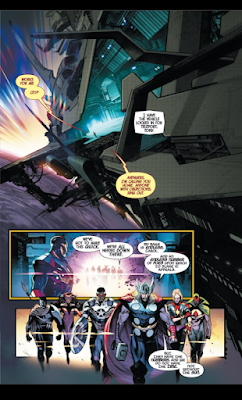
That's the Impossible City, a huge, um, city-sized space ship from another dimension. Possibly sapient, but with its memory and history erased, and with a distinctive teleportation ability, with which it opens "doors" to locations the Avengers need to access to do Avengering.

That's the Carrier, a huge city-sized space ship from another dimension. Possibly sapient, but with its memory and history erased, and with a distinctive teleportation ability, with which it opens "doors" to locations the Authority needs to access to do cynical posturing and widescreen property damage.
Hm.
Not least because the Avengers have -- since 2023 -- been zipping about in this:

That's the Impossible City, a huge, um, city-sized space ship from another dimension. Possibly sapient, but with its memory and history erased, and with a distinctive teleportation ability, with which it opens "doors" to locations the Avengers need to access to do Avengering.

That's the Carrier, a huge city-sized space ship from another dimension. Possibly sapient, but with its memory and history erased, and with a distinctive teleportation ability, with which it opens "doors" to locations the Authority needs to access to do cynical posturing and widescreen property damage.
Hm.
Tuesday, March 04, 2025
Subscribe to:
Posts (Atom)