We're still playing Silent Titans, although I am expecting my players to revolt very soon. Here are some pictures.
Eliuda Octave, an NPC, who is described as a "historian" but is also, apparently, a drunk.
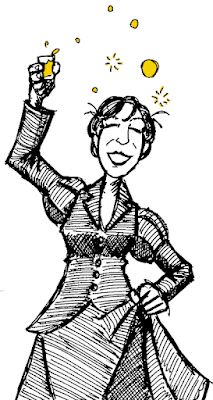
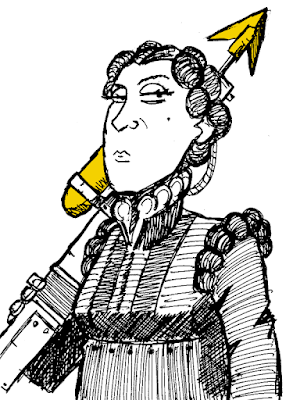
Emily Gondal, a player-character. A Georgian governess with a harpoon gun, because it's Silent Titans and that's the sort of thing that happens here.
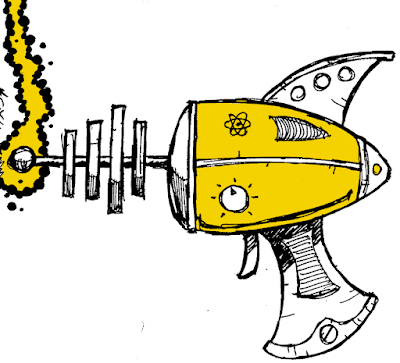
A ray gun looted from an evil Pig-Man. The players don't know what it does.
I'm Kelvin Green. I draw, I write, I am physically grotesque, and my hair is stupid.
Sunday, February 27, 2022
Monday, February 21, 2022
Masque Crusaders, Working Overtime
There is a half-decent idea here.
Let's take Ravenloft...
Wait, what's a Ravenloft?
Right, so it's Dungeons & Dragons does Universal -- or if you have excellent taste, Hammer -- horror. It's a patchwork world in which each of the classic horror archetypes rules over a little fiefdom, terrorising the locals, and the players go around staking vampires and shoving silver up werewolves, while trying not to draw the attention of the evil Darklords. The twist is that the bad guys are trapped there too, for Reasons, so if you wanted to you could examine concepts of destiny, responsibility, and enforced roles, but it's D&D so of course you don't do that.
Anyway. Masque of the Red Death and Other Tales backports the Ravenloft mechanics and setup to Earth in the 1890s, so instead of Tesco Value Dracula, you can fight actual Dracula, which is nice. All of the classic bad guys -- and some good guys, like Sherlock Holmes -- are running about, and ruling over the whole lot is the Red Death. What the Red Death is or does is not defined, which as we will see, is a bit of a recurring problem.
(The Red Death is more or less Nyarlathotep, but is never named as such, probably because of licensing reasons.)
I like the basic idea, I even admire the attempt to use AD&D2 for a near-modern setting, but the whole thing is a mess, veering from cack-handed to half-hearted and back. It's a shame.
Some examples:
It's unwieldy from the start. To play you need the AD&D2 books, this boxed set, plus the Ravenloft boxed set, and the Ravenloft: Forbidden Lore boxed set. The latter two you need for a couple of rules mechanics that could have been reprinted here -- as we will see, it's not like the space was needed for anything else -- but ah, then you'd be buying only one box, not three and how then would TSR avoid going bust?
Oh.
Imagine playing this in 1994, before everyone had pdfs. Imagine you were the GM but you were running the game at someone else's house, and you'd need to lug three boxes plus rulebooks plus whatever else over there. Crikey.
The setting-specific rules -- the ones that you don't have to go and find in other boxes -- are a bit of a mess too. AD&D2 for the 1890s was always going to be a fudge but it feels like they just gave up after a first draft. Fighters/soldiers are the only viable character type; magic use has interesting drawbacks -- corruption, insanity, attracting the Red Death -- but they are also probably too punitive to make playing a magician worthwhile, although I love that sort of thing in Warhammer Fantasy Roleplay so (shrugs).
Thieves become "tradesmen" and lose their thief skills, but get them back as Non-Weapon Proficiencies, the effectiveness of which are based on the character's -- random -- statistics, and must be bought from a pool of points of which the magic users will in most cases get more, AND the tradesman doesn't in fact get default access to the thief skills -- no one does -- so has to spend more of that pool of points to get them.
"You can play these other classes," TSR seems to say, "But they are crap, so don't bother." Soldiers for everyone! Which is fine, I suppose, if that was the intent, but if so why bother with the other classes -- the tradesman in particular, who is crippled by these rules -- at all? I can imagine that further development could fix the issues with the other classes, or even shift to a classless variant, but that didn't happen.
There's a section on explosives, because blowing monsters up is great! It has three tables, two of which are identical, and the third is different in only one place. Why do these tables exist? I'm not picking on one section; it's all like this.
In fairness some parts work better than others, and you could probably fix the rules, but once you've done that, what do you do in Masque of the Red Death and Other Tales? How are you supposed to play? Excellent questions.
You can't use most D&D adventures because it's Earth in the 1890s. You could use Ravenloft adventures because they at least have the right mood and are similar in setting, but for some odd reason that's never floated as a possibility. There are three adventures in the box, one of which isn't bad, one is an interesting idea executed as a linear series of fights, and one is dead in the water -- literally -- and wastes a major character.
Well, you don't need example adventures, not if the setting guide is full of evocative plot seeds and compelling adventure ideas.
(Spoiler: it is not.)
The setting is vague and underwritten in that annoying style that was everywhere in the 90s, all "rumours" this and "unconfirmed" that. It's all quite terrible, but this is perhaps the best/worst example, from the Australia section:
Whahuh? I can see words there, but I see no actual content. Someone was paid money to write that. This particular idiot paid money to read it.
Look, I know you can't cover everything in an introductory box, but this sort of non-committal nothingness is of no use to anyone. I would have put in some concrete examples, perhaps mentioning specific D&D monsters that could be used for the basis of an adventure, even mentioning published adventures that could be slotted in. Anything other than the "I dunno, you sort it out" we get.
(There is one weird exception. Singapore gets a few lines about a very specific incident involving tiny creatures that make people disappear. There's not much more than that, and no suggestion of what the things are, but it's something.)
The Red Death, the Big Bad of the setting, is left completely undefined, except that it might be living in Vienna, except that's probably just -- wait for it -- a rumour. Okay, fair enough, I understand not specifying what the Red Death is, but maybe offer three examples, Dracula Dossier style, of what it could be. That way the GM can take one and use as is, or use the three as examples to develop their own Red Death. This is not difficult, and my gosh, it's not as if the page space is being used for anything important.
I'm not sure why this box exists. I can't imagine fans were clamouring for a Ravenloft-but-the-1890s product and it seems like an odd thing to release as a boxed set, although 1994 was in the era of TSR spaffing out as many boxed sets as they could. My guess is that it's an unfortunate confluence of someone making a joke pitch over lunch in the TSR canteen, and a sudden box shaped gap in the production schedule; the pitch got commissioned and then everyone scrabbled to get the thing out. It feels like an initial idea shoved out the door before it was ready. Perhaps it was an attempt to compete with Call of Cthulhu, but if so it's the most lacklustre attempt imaginable.
Masque of the Red Death and Other Tales is a broken product that requires umpteen other products to use, it feels unfinished, and what is included is of little use, so I wouldn't recommend tracking this one down. All that said, there is still something compelling about the basic concept, something that got me to buy it in the first place.
(I think; I don't remember when I got my copy or even if I bought it at all. It may have been a gift.)
With quite a lot of further development -- which it is obvious never happened with the published box -- Masque of the Red Death and Other Tales could work. Maybe. Ish.
I give it two Draculas out of five.
Let's take Ravenloft...
Wait, what's a Ravenloft?
Right, so it's Dungeons & Dragons does Universal -- or if you have excellent taste, Hammer -- horror. It's a patchwork world in which each of the classic horror archetypes rules over a little fiefdom, terrorising the locals, and the players go around staking vampires and shoving silver up werewolves, while trying not to draw the attention of the evil Darklords. The twist is that the bad guys are trapped there too, for Reasons, so if you wanted to you could examine concepts of destiny, responsibility, and enforced roles, but it's D&D so of course you don't do that.
| I will say this, it's a great cover. Do we ever find out who the Skull Guy is or why he's on a train? No. We do not. |
(The Red Death is more or less Nyarlathotep, but is never named as such, probably because of licensing reasons.)
I like the basic idea, I even admire the attempt to use AD&D2 for a near-modern setting, but the whole thing is a mess, veering from cack-handed to half-hearted and back. It's a shame.
Some examples:
It's unwieldy from the start. To play you need the AD&D2 books, this boxed set, plus the Ravenloft boxed set, and the Ravenloft: Forbidden Lore boxed set. The latter two you need for a couple of rules mechanics that could have been reprinted here -- as we will see, it's not like the space was needed for anything else -- but ah, then you'd be buying only one box, not three and how then would TSR avoid going bust?
Oh.
Imagine playing this in 1994, before everyone had pdfs. Imagine you were the GM but you were running the game at someone else's house, and you'd need to lug three boxes plus rulebooks plus whatever else over there. Crikey.
The setting-specific rules -- the ones that you don't have to go and find in other boxes -- are a bit of a mess too. AD&D2 for the 1890s was always going to be a fudge but it feels like they just gave up after a first draft. Fighters/soldiers are the only viable character type; magic use has interesting drawbacks -- corruption, insanity, attracting the Red Death -- but they are also probably too punitive to make playing a magician worthwhile, although I love that sort of thing in Warhammer Fantasy Roleplay so (shrugs).
Thieves become "tradesmen" and lose their thief skills, but get them back as Non-Weapon Proficiencies, the effectiveness of which are based on the character's -- random -- statistics, and must be bought from a pool of points of which the magic users will in most cases get more, AND the tradesman doesn't in fact get default access to the thief skills -- no one does -- so has to spend more of that pool of points to get them.
"You can play these other classes," TSR seems to say, "But they are crap, so don't bother." Soldiers for everyone! Which is fine, I suppose, if that was the intent, but if so why bother with the other classes -- the tradesman in particular, who is crippled by these rules -- at all? I can imagine that further development could fix the issues with the other classes, or even shift to a classless variant, but that didn't happen.
There's a section on explosives, because blowing monsters up is great! It has three tables, two of which are identical, and the third is different in only one place. Why do these tables exist? I'm not picking on one section; it's all like this.
In fairness some parts work better than others, and you could probably fix the rules, but once you've done that, what do you do in Masque of the Red Death and Other Tales? How are you supposed to play? Excellent questions.
You can't use most D&D adventures because it's Earth in the 1890s. You could use Ravenloft adventures because they at least have the right mood and are similar in setting, but for some odd reason that's never floated as a possibility. There are three adventures in the box, one of which isn't bad, one is an interesting idea executed as a linear series of fights, and one is dead in the water -- literally -- and wastes a major character.
Well, you don't need example adventures, not if the setting guide is full of evocative plot seeds and compelling adventure ideas.
(Spoiler: it is not.)
The setting is vague and underwritten in that annoying style that was everywhere in the 90s, all "rumours" this and "unconfirmed" that. It's all quite terrible, but this is perhaps the best/worst example, from the Australia section:
The arrival of the Europeans has resulted in the violation of old taboos and the disruption of countless traditions. The exact nature of these trespasses and their repercussions may not be known for decades to come. Interviews with the native population of Australia tend to be less than informative, for many of the taboos forbid even the discussion of them.
Whahuh? I can see words there, but I see no actual content. Someone was paid money to write that. This particular idiot paid money to read it.
Look, I know you can't cover everything in an introductory box, but this sort of non-committal nothingness is of no use to anyone. I would have put in some concrete examples, perhaps mentioning specific D&D monsters that could be used for the basis of an adventure, even mentioning published adventures that could be slotted in. Anything other than the "I dunno, you sort it out" we get.
(There is one weird exception. Singapore gets a few lines about a very specific incident involving tiny creatures that make people disappear. There's not much more than that, and no suggestion of what the things are, but it's something.)
The Red Death, the Big Bad of the setting, is left completely undefined, except that it might be living in Vienna, except that's probably just -- wait for it -- a rumour. Okay, fair enough, I understand not specifying what the Red Death is, but maybe offer three examples, Dracula Dossier style, of what it could be. That way the GM can take one and use as is, or use the three as examples to develop their own Red Death. This is not difficult, and my gosh, it's not as if the page space is being used for anything important.
I'm not sure why this box exists. I can't imagine fans were clamouring for a Ravenloft-but-the-1890s product and it seems like an odd thing to release as a boxed set, although 1994 was in the era of TSR spaffing out as many boxed sets as they could. My guess is that it's an unfortunate confluence of someone making a joke pitch over lunch in the TSR canteen, and a sudden box shaped gap in the production schedule; the pitch got commissioned and then everyone scrabbled to get the thing out. It feels like an initial idea shoved out the door before it was ready. Perhaps it was an attempt to compete with Call of Cthulhu, but if so it's the most lacklustre attempt imaginable.
Masque of the Red Death and Other Tales is a broken product that requires umpteen other products to use, it feels unfinished, and what is included is of little use, so I wouldn't recommend tracking this one down. All that said, there is still something compelling about the basic concept, something that got me to buy it in the first place.
(I think; I don't remember when I got my copy or even if I bought it at all. It may have been a gift.)
With quite a lot of further development -- which it is obvious never happened with the published box -- Masque of the Red Death and Other Tales could work. Maybe. Ish.
I give it two Draculas out of five.
Tuesday, February 15, 2022
Stag Do
Last weekend, my group started playing Patrick Stuart's -- not that one -- weird sandbox adventure Silent Titans. I haven't yet decided if I'll post game summaries, as I don't want to spoil things for anyone that hasn't played it yet. Thinking.
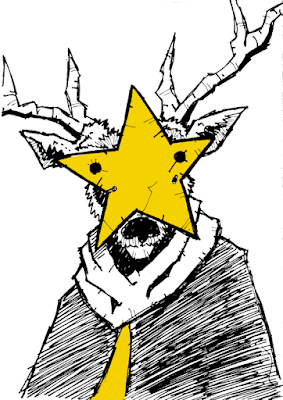
In the mean time, here is Godbold Stag-Star, one of the player characters:
He's a dapper mesmerist, with an opera cloak and a glass sword. He's also a humanoid stag, because that's Silent Titans for you.
In the mean time, here is Godbold Stag-Star, one of the player characters:
He's a dapper mesmerist, with an opera cloak and a glass sword. He's also a humanoid stag, because that's Silent Titans for you.
Labels:
Silent Titans,
stuff that I drew
Tuesday, February 08, 2022
Going Grey
Another from my upcoming Lamentations of the Flame Princess book:
This is in fact a filler piece because we ended up with pages left over after layout, but it turned out to be one of my favourite bits from the book.
Monday, February 07, 2022
Friday, February 04, 2022
Night Night
The original version of this had a fancy gradient in the night sky, but (a) the file size was huge, and (ii) this flat version looked better.
Wednesday, January 26, 2022
2022 Squarecrawl: B05 - New Dezoris
Here's the starting town for the "squarecrawl" I showed in a previous post. This is the information that would be available to the players; other details would be uncovered in play, although there are some hints in here for sharp-eyed detectives. None of which is massively important; this should be a home base for adventures in the wilderness, rather than a source of adventure itself.
B05: When minions of the plague god razed Dezoris (A05), the survivors fled to the east and camped within the protective walls of an ancient ruin. Over decades, this camp became the town of New Dezoris. Closer to the river and with the protection of the walls, this turns out to be a much better location for the settlement, although some elderly residents still miss their old homes.
- The wall is constructed of an unknown white material. It is smooth and unblemished and runs in a perfect ring around the town, apart from one wide opening in the south.
- The population of about 400 runs the town via a council of 11, chosen by lottery each year. Living in New Dezoris for 90 days earns you a place in the council lottery. Important matters are often decided by a vote of the entire official population. Old Dezoris was run a by a noble class; the current population, in general, prefers the new system.
- There is a mill, a small dock just outside the ringwall, two trading posts, a forester, and a market on Wednesdays and Saturdays.
- The most popular inn is The Roaring Mug, which is of average quality. It is known for the many decorative pelts and skins hanging from its walls, and the innkeeper offers a free drink and meal for anyone that can bring in a -- hunted -- pelt that he hasn't seen before. The speciality is deep-fried crow.
- The town's other main inn is The Jar & Raven, which is of fair quality.
- Both inns field teams for the local tavern brawl league. As expected, both teams consider the other a rival, but there is also rivalry with the teams of Drogan's Pass (D02).
- There are no temples in New Dezoris, but there is a small shrine to Tyrest, the god of justice and patron deity of Old Dezoris; the young priest wants to consecrate this shrine with a religious festival but has not yet received permission from the council.
Labels:
2022 square crawl,
stuff you can use
Monday, January 24, 2022
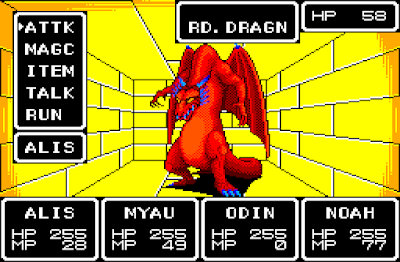
Let Me Be Your Phantasy
I finished Phantasy Star!
It only took about 30 years.
I'm pretty sure Phantasy Star was the first computer role-playing game I encountered. The genre wasn't common in the UK in the 80s, I think because tape was the medium of choice for home computers and most of the big name rpgs were released on disk, and because console rpg releases were spotty in Europe until Final Fantasy VII crashed in and changed everything. I got my copy of PS at some point around 1992, second hand and without a manual, five years after the Japanese release, from a fellow called Graham, who operated a "computer club" from a converted stable, and yes, in hindsight the whole thing seems a bit dodgy.
I have no idea why I picked Phantasy Star up. I hadn't heard of it, and I wasn't into rpgs in general at that point, beyond the Fighting Fantasy phase every 80s kid went through. Whatever the reason, I fell in love with the game, and despite having no manual, and with no coverage in the magazines of the day -- because, remember, it was five years old and it was all about Sonic by then -- I somehow muddled through. I remember getting about halfway through the game when the save erased itself; it wasn't the battery because I started again and the saves were fine. A mystery for the ages.
(I also played it for hours in a bedroom that my father was painting, so I always associate the game with the smell of paint, and vice versa.)
I didn't finish that second play either, because I became distracted by other things. The PlayStation came out. I discovered actual tabletop rpgs. I mutated into a hormonal teenager. Beer. Girls. And so on.
In 2009, Phantasy Star came out on the Wii's Virtual Console, and I gave it another try, this time as a sort-of-professional. I didn't finish it that time, either, which is probably a breach of journalistic ethics.
Later, I got it as part of a collection of old Sega games for the PlayStation 3 and decided that this time I would complete it. Reader, I did not.
And then in January 2022 something in me -- possible because we recently had our kitchen painted; that smell! -- made me try again, this time via emulation, and in four lengthy sessions, I did it. I finished Phantasy Star. I didn't get every character to level 30, but there's no difference to the game if you do so, so I'm happy to let that go. I did defeat the "impossible" Saccubus, which I had done only once before in my many, many playthroughs, so I'll consider that an achievement.
But finishing the game at all, after a literal lifetime, is what's important. Well, not in fact important, obviously, but you get my meaning. Important to me. Phantasy Star has been part of my life for so long, always there, from when I was a child, discovering the world of console gaming, to when I was -- briefly! -- a computer game journalist, and now as I turn grey and withered, as an actual games designer, albeit in a different medium.
Will I go back and play it again? I'm not sure I will, in part because I've seen everything it has to offer over my many attempts, but in part because I always put off playing the three sequels until I finished the first one.
The road, as they say, goes ever on.
It only took about 30 years.
I'm pretty sure Phantasy Star was the first computer role-playing game I encountered. The genre wasn't common in the UK in the 80s, I think because tape was the medium of choice for home computers and most of the big name rpgs were released on disk, and because console rpg releases were spotty in Europe until Final Fantasy VII crashed in and changed everything. I got my copy of PS at some point around 1992, second hand and without a manual, five years after the Japanese release, from a fellow called Graham, who operated a "computer club" from a converted stable, and yes, in hindsight the whole thing seems a bit dodgy.
I have no idea why I picked Phantasy Star up. I hadn't heard of it, and I wasn't into rpgs in general at that point, beyond the Fighting Fantasy phase every 80s kid went through. Whatever the reason, I fell in love with the game, and despite having no manual, and with no coverage in the magazines of the day -- because, remember, it was five years old and it was all about Sonic by then -- I somehow muddled through. I remember getting about halfway through the game when the save erased itself; it wasn't the battery because I started again and the saves were fine. A mystery for the ages.
(I also played it for hours in a bedroom that my father was painting, so I always associate the game with the smell of paint, and vice versa.)
I didn't finish that second play either, because I became distracted by other things. The PlayStation came out. I discovered actual tabletop rpgs. I mutated into a hormonal teenager. Beer. Girls. And so on.
In 2009, Phantasy Star came out on the Wii's Virtual Console, and I gave it another try, this time as a sort-of-professional. I didn't finish it that time, either, which is probably a breach of journalistic ethics.
Later, I got it as part of a collection of old Sega games for the PlayStation 3 and decided that this time I would complete it. Reader, I did not.
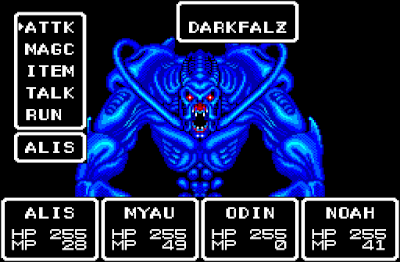
| This chunky fellow is standing right on top of a hidden trap door. Does he set it off? He does not. Unfair, I say! |
But finishing the game at all, after a literal lifetime, is what's important. Well, not in fact important, obviously, but you get my meaning. Important to me. Phantasy Star has been part of my life for so long, always there, from when I was a child, discovering the world of console gaming, to when I was -- briefly! -- a computer game journalist, and now as I turn grey and withered, as an actual games designer, albeit in a different medium.
Will I go back and play it again? I'm not sure I will, in part because I've seen everything it has to offer over my many attempts, but in part because I always put off playing the three sequels until I finished the first one.
The road, as they say, goes ever on.
Labels:
computer games,
Phantasy Star
Monday, January 17, 2022
"Hex" Is Latin for "Four"
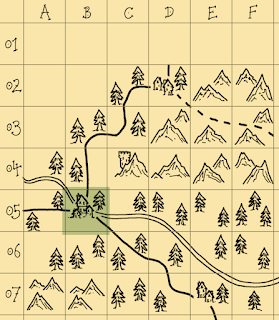
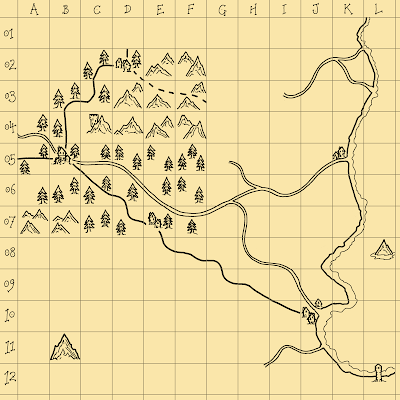
I spent a couple of hours in the evenings last week putting together an old-school "hex" crawl setting. Here's the player map:
The starting town -- New Dezoris -- is at B05 and there's a six by six area in which to roam around in the first few sessions. After that, the players will have to explore and fill in the map for themselves. Old-school!
I won't post the complete map, just in case I get it to the table some time, but you can always email me -- look to the top-right -- if you want the whole thing.
Why is it not a proper hex map? I've never liked hexes. Don't know why!
The starting town -- New Dezoris -- is at B05 and there's a six by six area in which to roam around in the first few sessions. After that, the players will have to explore and fill in the map for themselves. Old-school!
I won't post the complete map, just in case I get it to the table some time, but you can always email me -- look to the top-right -- if you want the whole thing.
Why is it not a proper hex map? I've never liked hexes. Don't know why!
Labels:
2022 square crawl,
maps,
stuff that I drew,
stuff you can use
Monday, January 10, 2022
IRON BRUTE
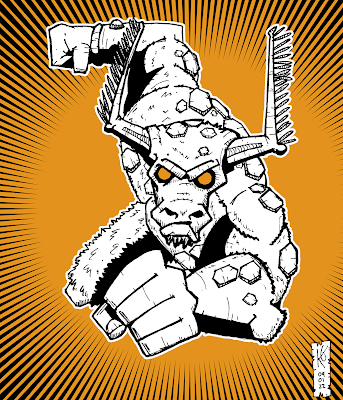
This is all based on me misreading (Sir) Ian Livingstone's handwriting on this map.
RUST MINOTAURS, also known as "IRON BRUTES" by northern folk, are aggressive and terrifying hybrids of -- wait for it -- minotaurs and rust monsters, although they seem to take more of their characteristics from the homicidal bovine side. Those ever-clueless sages speculate that the iron brutes were first created by a mad wizard, but that's their excuse for anything they can't explain, and is probably a result of professional jealousy.
RUST MINOTAUR: Armour 15, Move 120’, 6* Hit Dice, 27hp, rusty horns or weapon +2, Morale 12.
Rust minotaurs can attack with either their horns or a weapon, not both, in a single Round. The iron brute's horns destroy metal at a touch. Magical armour and weapons get 10% resistance per "plus" of enchantment.
The rust minotaur can metabolise enchanted metal and convert it into temporary armour plating, taking the form of hexagonal metallic scales. Every "plus" destroyed by the creature's touch, is converted to a point of armour, which erupts from the monster's hide a Round after it is absorbed. This bonus armour flakes away after a day.
If you are playing Troika! or a similar game of fantasy fighting, then you can use the following statistics:
SKILL 9
STAMINA 9
Initiative 3
Armour 0 (but see below)
Damage as Weapon or Rusty Horns
If a Rust Minotaur hits with its Rusty Horns attack, the target takes no damage but instead loses 1 point of armour, to a minimum of 0. If the armour was magical, the iron brute gains this point of absorbed armour at the End of the Round. These bonus points of protection have no maximum, but on the plus side, they disappear after a day. Good luck!
RUST MINOTAURS, also known as "IRON BRUTES" by northern folk, are aggressive and terrifying hybrids of -- wait for it -- minotaurs and rust monsters, although they seem to take more of their characteristics from the homicidal bovine side. Those ever-clueless sages speculate that the iron brutes were first created by a mad wizard, but that's their excuse for anything they can't explain, and is probably a result of professional jealousy.
RUST MINOTAUR: Armour 15, Move 120’, 6* Hit Dice, 27hp, rusty horns or weapon +2, Morale 12.
Rust minotaurs can attack with either their horns or a weapon, not both, in a single Round. The iron brute's horns destroy metal at a touch. Magical armour and weapons get 10% resistance per "plus" of enchantment.
The rust minotaur can metabolise enchanted metal and convert it into temporary armour plating, taking the form of hexagonal metallic scales. Every "plus" destroyed by the creature's touch, is converted to a point of armour, which erupts from the monster's hide a Round after it is absorbed. This bonus armour flakes away after a day.
If you are playing Troika! or a similar game of fantasy fighting, then you can use the following statistics:
SKILL 9
STAMINA 9
Initiative 3
Armour 0 (but see below)
Damage as Weapon or Rusty Horns
If a Rust Minotaur hits with its Rusty Horns attack, the target takes no damage but instead loses 1 point of armour, to a minimum of 0. If the armour was magical, the iron brute gains this point of absorbed armour at the End of the Round. These bonus points of protection have no maximum, but on the plus side, they disappear after a day. Good luck!
Subscribe to:
Posts (Atom)