Mercy Point, a 1998 TV series about a 23rd century space hospital:
Mercy Heights, a 1997 story in 2000AD about a 23rd century space hospital:
Hm.
I'm Kelvin Green. I draw, I write, I am physically grotesque, and my hair is stupid.
Showing posts with label 2000AD. Show all posts
Tuesday, June 02, 2026
Where Did All the Blue Sky Go?
Wednesday, October 01, 2025
Cadet Zenith
Cadet Marvel, a teen sidekick for Captain Marvel, from 2023:
Zenith, 2000AD's pop star superhero, from 1987:
Hm.
Zenith, 2000AD's pop star superhero, from 1987:
Hm.
Labels:
2000AD,
Cadet Marvel,
seems familiar,
Zenith
Wednesday, May 21, 2025
4000ad
I've been looking through my 2000ad collection* and I thought I'd highlight this one: Prog 2000, released in December 1999 as a double celebration; a big end-of-year special, and a semi-surprised "Crikey!" that 2000ad lasted up to, well, 2000AD, when pretty much every other British comic -- aside from stuff like The Beano or Commando that will likely survive the heat death of the universe -- had folded years before.
This is more properly Prog 1173.5 -- the "real" Prog 2000 would come in 2016 -- but given the date of publication, I can understand why they would jump the gun. This started** a tradition of big end-of-year specials that were numbered by year until 2016 when they switched to the weekly numbering, so there were also two 2001s, two 2002s, and so on.
Still with me?
I don't get many of the weekly issues these days but I always pick up the big end-of-year specials, and I think this first one is one of the best. As a look back at the glory days of the comic, they managed to bring back some big name artists who had long before departed for the US comics industry. There's a cover from Brian Bolland -- who apparently "enthusiastically agreed" -- Dave Gibbons coming back to draw a Rogue Trooper -- sort of -- story, Kevin O'Neill returning for the final episode of the batshit insane Nemesis the Warlock, and Mike McMahon and Cam Kennedy on the two Judge Dredd stories.
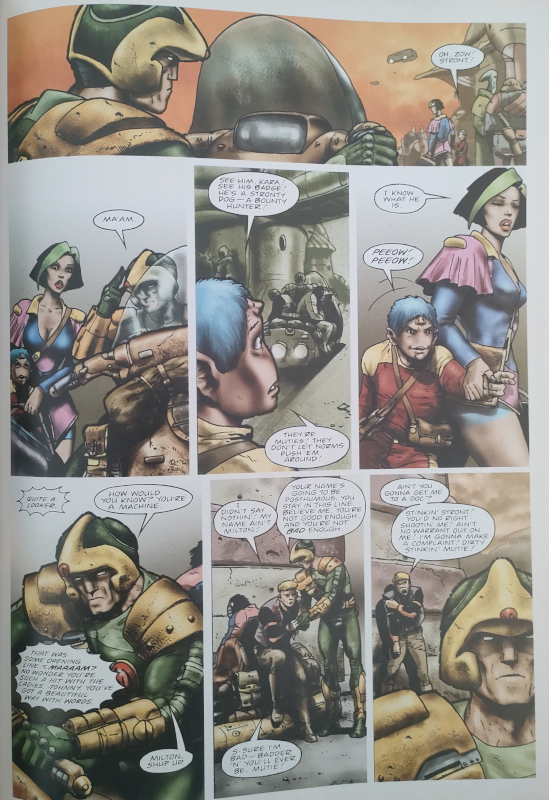
Aside from the "old" superstars, you've got incredible detailed black and white art from Kev Walker on ABC Warriors, the underrated Simon Fraser on Nikolai Dante, the genius Carlos Ezquerra on Strontium Dog, glorious painting from Greg Staples on Sláine and Simon Davis on Sinister Dexter, and Mark Harrison's impossible*** paint/digital hybrid art on Glimmer Rats.
Not every story is good, as such, but it all looks amazing, and is probably the most consistently good-looking of the specials.
Here, have a look:
Mike McMahon:
Dave Gibbons: Kev Walker. Good gosh, look at it:
Simon Fraser. Most of this story is a sex scene, and I try to keep this blog relatively family friendly, so you get crying in the rain instead:
Carlos Ezquerra, experimenting with some slightly dodgy 1999 computer effects:
Greg Staples. This is a weekly comic, remember: Simon Davis, ditto: Kevin O'Neill, the only person to have his entire art style banned by DC Comics. Their loss: Mark Harrison, the same one who drew "The Travellers" in White Dwarf, engaging in some sort of sorcery: Cam Kennedy:
Not bad for £3.95 Earth money!
This is more properly Prog 1173.5 -- the "real" Prog 2000 would come in 2016 -- but given the date of publication, I can understand why they would jump the gun. This started** a tradition of big end-of-year specials that were numbered by year until 2016 when they switched to the weekly numbering, so there were also two 2001s, two 2002s, and so on.
Still with me?
I don't get many of the weekly issues these days but I always pick up the big end-of-year specials, and I think this first one is one of the best. As a look back at the glory days of the comic, they managed to bring back some big name artists who had long before departed for the US comics industry. There's a cover from Brian Bolland -- who apparently "enthusiastically agreed" -- Dave Gibbons coming back to draw a Rogue Trooper -- sort of -- story, Kevin O'Neill returning for the final episode of the batshit insane Nemesis the Warlock, and Mike McMahon and Cam Kennedy on the two Judge Dredd stories.
Aside from the "old" superstars, you've got incredible detailed black and white art from Kev Walker on ABC Warriors, the underrated Simon Fraser on Nikolai Dante, the genius Carlos Ezquerra on Strontium Dog, glorious painting from Greg Staples on Sláine and Simon Davis on Sinister Dexter, and Mark Harrison's impossible*** paint/digital hybrid art on Glimmer Rats.
Not every story is good, as such, but it all looks amazing, and is probably the most consistently good-looking of the specials.
Here, have a look:
Mike McMahon:
Dave Gibbons: Kev Walker. Good gosh, look at it:
Simon Fraser. Most of this story is a sex scene, and I try to keep this blog relatively family friendly, so you get crying in the rain instead:
Carlos Ezquerra, experimenting with some slightly dodgy 1999 computer effects:
Greg Staples. This is a weekly comic, remember: Simon Davis, ditto: Kevin O'Neill, the only person to have his entire art style banned by DC Comics. Their loss: Mark Harrison, the same one who drew "The Travellers" in White Dwarf, engaging in some sort of sorcery: Cam Kennedy:
Not bad for £3.95 Earth money!
*(It's not much of a collection; a few issues from when I was reading the weekly comic, and every end-of-year special since 2000.)
**(There had been the traditional British Christmas annuals -- different to US comic annuals -- but those stopped in the 1990s... except they did an annual in 2025, in addition to the special, just to confuse matters.)
***(I can't work out how he did it in 1999, anyway.)
Monday, November 20, 2023
The Judge Who Laughs
The Batman Who Laughs, an evil version of Batman from an alternate universe, introduced in 2017:
Judge Death, an evil counterpart of Judge Dredd, from an alternate universe, introduced in 1980:
Hm.
(And yes, I know I'm years late on this.)
Judge Death, an evil counterpart of Judge Dredd, from an alternate universe, introduced in 1980:
Hm.
(And yes, I know I'm years late on this.)
Labels:
2000AD,
Batman,
Judge Dredd,
seems familiar
Tuesday, February 07, 2023
Cradlegrave
Well, it can't all be Dungeon23 content!
I got this book for Chrimble and have been thinking about it ever since. I think I'm ready to put those thoughts down in words. Maybe. Ish.
Published over 11 weeks in sci-fi-mostly anthology comic 2000AD in 2009, Cradlegrave looks very much like an entry in the "Hoodie Horror" genre, and it sort of is, but the cover is a bit misleading. I'll go into more spoilery discussion below, but if you want a brief non-spoilerific review: it's an effective and interesting modern(ish) horror story, with clever writing and excellent art, and it is much recommended.
And now, the meaty bits...
Aside; Hoodie Horror: Former Prime Minister and pig-botherer in chief David Cameron appealed to the middle-classes with his vision of "Broken Britain" in which THE POOR -- gasp! -- were waiting, with hoods and knives, to rape, stab, and steal from good honest hard working Britons and, of course, only a Conservative government could prevent this, mainly by freezing or starving the poor to death, a shameful policy that continues to this day.
This vision spawned a brief mini genre of horror film in which hooded youths became the faceless monsters in the dark, lurking on their estates, ready to pounce. These films were sometimes supernatural, more often not, but were almost always conservative in tone, disgusted and horrified by Britain's "underclass". Eden Lake (2008) is perhaps the most famous example, Harry Brown (2009) the most offensive, and Attack the Block (2011) is a notable inversion or retort, to which we will return.
For more on the genre, there are excellent brief introductions here and here.
So, Cradlegrave then. What we have here is a horror story set on a housing estate somewhere in sunny Lancashire. Ravenglade is the official name, but the locals call it "Cradlegrave" because no one ever escapes; you are born there, you live there, and you die there. Social mobility is a myth told by the rich. Our protagonist, Shane, returns from a stint in a Young Offender Institution intent on making a fresh start and not falling into old habits with old friends, only to find that there is something rotten at the heart of the estate. Something alien.
"Lovecraftian" is the obvious description, and it is superficially so, with a horrible gribbly thing spurting out "black milk" like Shub-Niggurath itself, and even a nascent cult forming around the creature, but I suspect old Howard would have recoiled from the portrayal of the youths as misunderstood rather than irredeemable scum. Like Attack the Block -- I said we'd return -- Shane and his friends are petty criminals who drink and smoke and take drugs, but -- crucially -- that doesn't make them bad people. Their lifestyle is very much presented as a response to the deprivation of their surroundings, almost an adaptation to things they cannot themselves control. There is no judgement; this is all bad, but it's the way it is, and it's not always their fault.
In fact, the real horror turns out to be the nice old couple down the road, Ted and Mary, who just wish for things to go back to the way they were in happier times, before the estate -- and, one suspects, the people -- sprang up around them. Literal "old ones", but perhaps not in the way Lovecraft would have intended. Mary is, or has been physically co-opted by, some sort of entity and begins corrupting the estate; Ted helps her at first, but when it becomes clear that the thing in the bedroom is no longer his wife, escapes in the only way he can. As the corruption spreads and what little social order there is breaks down, it is up to Shane to take action, which he does through a firebomb, reprising the crime that put him in prison in the first place.
It's a bleak, dark story. Edmund Bagwell's art is both mundane at depicting the realities of life on the estate and gruesome when presenting the alien body horror of Mary's transformation and how she, um, "interacts" with the locals. There is little sense of hope. You get the feeling that the estate falls under Mary's sway as much because it's something to do as any overt alien influence. Shane escapes and leaves the horror behind, but while he perhaps "wins", it's clear that not only does the horror continue in his absence, but his fresh start was a, um, non-starter. And of course the larger social issues remain unresolved; you can lob a Molotov at a monster, but you can't burn down decades of deprivation and lack of social support, you can't burn down a class system that is stacked against the poorest and most vulnerable.
(Unless you're French, probably.)
The only way to win is to burn everything down and run away. That's bare bleak, bruv.
Cradlegrave is a greasy, prickly, unpleasant little horror story, and I mean all of that as a compliment. It's deep and fascinating and I wish it was more well known. While Hoodie Horror is perhaps of its time, I think Cradlegrave still has things to say -- alas the poor are still demonised under the Tories -- and is still effective and relevant, like all the best horror stories.
I got this book for Chrimble and have been thinking about it ever since. I think I'm ready to put those thoughts down in words. Maybe. Ish.
Published over 11 weeks in sci-fi-mostly anthology comic 2000AD in 2009, Cradlegrave looks very much like an entry in the "Hoodie Horror" genre, and it sort of is, but the cover is a bit misleading. I'll go into more spoilery discussion below, but if you want a brief non-spoilerific review: it's an effective and interesting modern(ish) horror story, with clever writing and excellent art, and it is much recommended.
And now, the meaty bits...
Aside; Hoodie Horror: Former Prime Minister and pig-botherer in chief David Cameron appealed to the middle-classes with his vision of "Broken Britain" in which THE POOR -- gasp! -- were waiting, with hoods and knives, to rape, stab, and steal from good honest hard working Britons and, of course, only a Conservative government could prevent this, mainly by freezing or starving the poor to death, a shameful policy that continues to this day.
This vision spawned a brief mini genre of horror film in which hooded youths became the faceless monsters in the dark, lurking on their estates, ready to pounce. These films were sometimes supernatural, more often not, but were almost always conservative in tone, disgusted and horrified by Britain's "underclass". Eden Lake (2008) is perhaps the most famous example, Harry Brown (2009) the most offensive, and Attack the Block (2011) is a notable inversion or retort, to which we will return.
For more on the genre, there are excellent brief introductions here and here.
So, Cradlegrave then. What we have here is a horror story set on a housing estate somewhere in sunny Lancashire. Ravenglade is the official name, but the locals call it "Cradlegrave" because no one ever escapes; you are born there, you live there, and you die there. Social mobility is a myth told by the rich. Our protagonist, Shane, returns from a stint in a Young Offender Institution intent on making a fresh start and not falling into old habits with old friends, only to find that there is something rotten at the heart of the estate. Something alien.
"Lovecraftian" is the obvious description, and it is superficially so, with a horrible gribbly thing spurting out "black milk" like Shub-Niggurath itself, and even a nascent cult forming around the creature, but I suspect old Howard would have recoiled from the portrayal of the youths as misunderstood rather than irredeemable scum. Like Attack the Block -- I said we'd return -- Shane and his friends are petty criminals who drink and smoke and take drugs, but -- crucially -- that doesn't make them bad people. Their lifestyle is very much presented as a response to the deprivation of their surroundings, almost an adaptation to things they cannot themselves control. There is no judgement; this is all bad, but it's the way it is, and it's not always their fault.
In fact, the real horror turns out to be the nice old couple down the road, Ted and Mary, who just wish for things to go back to the way they were in happier times, before the estate -- and, one suspects, the people -- sprang up around them. Literal "old ones", but perhaps not in the way Lovecraft would have intended. Mary is, or has been physically co-opted by, some sort of entity and begins corrupting the estate; Ted helps her at first, but when it becomes clear that the thing in the bedroom is no longer his wife, escapes in the only way he can. As the corruption spreads and what little social order there is breaks down, it is up to Shane to take action, which he does through a firebomb, reprising the crime that put him in prison in the first place.
It's a bleak, dark story. Edmund Bagwell's art is both mundane at depicting the realities of life on the estate and gruesome when presenting the alien body horror of Mary's transformation and how she, um, "interacts" with the locals. There is little sense of hope. You get the feeling that the estate falls under Mary's sway as much because it's something to do as any overt alien influence. Shane escapes and leaves the horror behind, but while he perhaps "wins", it's clear that not only does the horror continue in his absence, but his fresh start was a, um, non-starter. And of course the larger social issues remain unresolved; you can lob a Molotov at a monster, but you can't burn down decades of deprivation and lack of social support, you can't burn down a class system that is stacked against the poorest and most vulnerable.
(Unless you're French, probably.)
The only way to win is to burn everything down and run away. That's bare bleak, bruv.
Cradlegrave is a greasy, prickly, unpleasant little horror story, and I mean all of that as a compliment. It's deep and fascinating and I wish it was more well known. While Hoodie Horror is perhaps of its time, I think Cradlegrave still has things to say -- alas the poor are still demonised under the Tories -- and is still effective and relevant, like all the best horror stories.
Labels:
2000AD,
Cradlegrave,
hoodie horror,
I review comics
Subscribe to:
Posts (Atom)