Showing posts with label breaking your game. Show all posts

Wednesday, May 31, 2023

Hoard of the Rings

4 donuts
Here's an idea that popped into my head and won't exit until I've written it down, so lucky for you.

ALL MAGIC ITEMS ARE RINGS.

So instead of a Cursed Shield, AC10, it's a Cursed Ring, AC10. Instead of a Sword +1/+2 vs Lycanthropes, it's a ring that provides the same bonus to all of the character's attacks.

You may want to keep some fun unique items, like the Deck of Horrible Things, as they are, as well as anything that really doesn't work as a ring. On the other hand -- ha ha -- it might be fun to have woefully inappropriate items shoved into a ring; a ring that is somehow a treasure map could be interesting. Perhaps the map is literally carved into the ring -- only visible in fire perhaps, what a clever idea I've just had -- or perhaps the map can be seen in the mind's eye of the wearer, like a cyberpunk HUD. Maybe potions are one-use rings, but I quite like potions, so probably not. I'd love to see what a Folding Boat would be like as a ring.

Most games have a limit of two rings per character, one per hand. When all magic items are rings, that puts a nice hard limit on magic item proliferation.

Thursday, February 23, 2023

Le Stat d'Dump

Charisma Carpenter May 2015
There seems to be some discussion going around about good old Charisma and its -- mostly unjustified -- reputation as a useless statistic in Dungeons & Dragons-likes. Here's a blog post by Richard about it, that I saw about two days after a Discord group was also discussing the matter. I assume there's some blog or video somewhere that kicked off people's interest, but I'm not hip enough to know where that is.

In the aforementioned Discord group I pondered for about 20 seconds, then blurted this nugget, or something like it:

Charisma represents your character's strength -- small s -- of personality, which among many other useful functions, also manifests as bloody-minded tenacity. When you reach 0 Hit Points, instead of collapsing into unconsciousness, you can fight on for a number of Rounds equal to your Charisma score before dying.

And there you have it!

EDIT: In hindsight, this is ridiculous, and not in the way I tend to like either. So maybe this is better:

Charisma represents your character's strength -- small s -- of personality, which among many other useful functions, also manifests as bloody-minded tenacity. When you reach 0 Hit Points, instead of collapsing into unconsciousness, you have temporary Hit Points equal to your Charisma score. Once these have run out you are properly dead.

That's a bit better. Charisma still has an effect, but doesn't make you invincible for 3-18 Rounds.

Tuesday, August 02, 2022

Getting Cross(-Edition)

Yesterday, I pondered the feasibility of a D&D party made up of characters from different editions. I also asked about it on The Hellsite Known As Twitter, and there Courtney Campbell of Hack & Slash replied with some actual experience of playing with cross-edition characters. Here's what Courtney said:

I've done this. It's fine. 5e characters and 4e characters require some hit point math, but it works pretty seamlessly. Turns out the player side and the DM side don't need the same rules to play, just an interface.

I've done this both in Numenhalla, and in home games with 2e, 5e, and 4e players. They can follow the PHB rules for their class. I just multiplied all damage 4e/5e characters took by 2, and cut their damage in half, and it worked fine.

I get the impression that Courtney is a top-level GM and perhaps it's not as easy as it seems, but it is possible!

Monday, August 01, 2022

All Together Now

Remember when they were developing D&D5 and they said it would be compatible with prior editions, and you could run characters from different editions in the same party? That didn't happen (SPOILERS) but I do wonder if it's a viable idea and anyone has tried it.

What would a cross-edition party look like? Perhaps something like this, says the person with very little experience of anything before fourth edition:

AD&D1: Half-orc assassin, surely?
AD&D2: Gnome illusionist, obviously.
D&D3: Warforged cleric, probably.
D&D4: Dragonborn fighter, presumably, since fourth was supposed to make fighters as special as everyone else.
D&D5: Roll 1d12 or GM's choice. Or a Warlock of Cthulhu, eldritchly.

I very much want to try this now.

Thursday, December 23, 2021

Near, Far, Wherever You Are

I've been thinking about something to make rpg combat easier to handle, both for the GM that doesn't want to have to prepare a full battlemat for every fight, and the player that has difficulty with pure, abstract "theatre of the mind" play. This is my attempt to resolve that tension. I remember The One Ring had something like this, so I may be just reinventing the wheel, but oh well it kept me occupied for an afternoon.

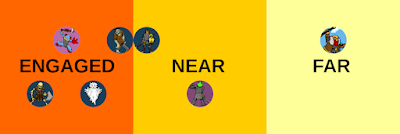
The basic idea is that a combat is split into three bands: Engaged, Near, and Far.

(You can click to see the image at a slightly larger size.)
Anyone in the Engaged band is, um, engaged. Anyone can hit anyone else, and it's a proper mêlée. That frog person is in trouble. Although it's a brawl, you may decide that "small" ranged weapons such as pistols and thrown weapons are effective in this section.

Anyone in the Near band can hit characters in Engaged and Near with ranged attacks. Engaged characters can attack those in Near with ranged attacks, but may face penalties or free attacks or similar from others in Engaged. Characters in Near can hit each other with ranged attacks, but for anything more up close and personal see NEE. Most ranged weapons, like bows or SMGs, fit in here.

Characters in Far are probably out of the fight but may have extra long range weapons that can affect the battle and hit anyone in any band. This is where your long distance spells, high-tech sniper rifles, or siege weapons come in.

You'll note that the guard (Near) and the zombie (Engaged) are adjacent on the "map", but remember this is abstract positioning and they are in different bands. In "reality" they could be 100 metres apart.

Moving
Characters can move between bands by using their basic combat move, as defined in your game of choice. Leaving Engaged will require some sort of dodge or fighting withdrawal action to escape the mêlée without harm. It takes one action/turn/whatever to move between sections; if your game allows double moves or sprinting, then you can move two bands.

Get the Archers!
My thinking is that if you want to go and stab the archers, you use your move action as normal, and that instead "pulls" the archer from Near to Engaged. It's a bit fuzzy because they haven't moved, rather the fight has sprawled and they've been sucked into its periphery. Don't think too hard about it; this is supposed to make combat simpler!

Backstabber!
Backstabs work as normal, I think. The stabber makes a stealth test -- which probably makes them ineligible for being attacked, even if Engaged -- then tries their sneak attack. It should all be compatible with this approach.

Flanking
Flanking and similar sort of tactical positioning is abstract and simple: if your side outnumbers the opponents in the Engaged band, you can gain a flanking bonus if your game has one.

Fleeing
You can handle running away as normal for your game. Or... If someone wants to flee combat, then they need to move from Engaged to Near to Far, and then once more to get "out" of the Far band, for a total of three movement actions.

Initiative
None of this should make any difference to your game's imitative rules, but I would consider applying some sort of penalty to those in the Far band. Perhaps they go last, or get a -10, or something like that, to represent their distance from the action.

NEE
If one Near character decides to engage another, then I suggest putting them in a temporary Near-Engaged Enclave (NEE). They are still at a distance from the main mêlée but are Engaged with each other. They can still attack those in the Engaged band, but would face the same penalties as someone attacking from Engaged to Near would. As soon as their personal duel ends, the survivors return to their Near status.

Surprise!
I don't think anything here should affect surprise, unless your game has some weird surprise mechanics.


That's it! I haven't tested it yet, but I'll try to use it as soon as I can. It will be interesting to see what effects if any it will have on gameplay. I imagine one thing it could encourage is a greater emphasis on marching order, with the elf ranger -- for example -- hanging back so she can take up a Near position if combat starts.

If you have a chance to try it out, let me know how you get on!

Monday, May 18, 2020

Today's Special

The other day I waffled about food in role-playing games and now here we are.

Roll 1d100 to determine your character's favourite foodstuff. Maybe eating it improves their morale, or if eaten during a rest your character gets extra healing. Dunno. I leave that up to you.

01 Vegetable lasagne 51 Sausage sandwich
02 Banoffee pie 52 Coffee ice cream
03 Bean burrito 53 Aubergine parmigiana
04 Bangers and mash 54 Three bean chilli
05 Egg fried rice 55 Heuvos rancheros
06 Aubergine katsu curry 56 Hot wings
07 Bread 57 Garlic bread
08 A nice cup of tea 58 Banana bread
09 Cucumber sandwich 59 Omelette
10 Spam 60 Meatball sandwich
11 Pineapple and jalapeño pizza 61 Cola
12 Apple crumble 62 Weird elf bread
13 Sunday roast 63 Full English
14 Big bag of Monster Munch 64 Cottage pie
15 Cheese and pickle sandwich 65 Calamari rings
16 Tomato soup 66 Pot noodle
17 Chocolate sponge cake 67 Toasted cheese sandwich
18 Barbecue ribs 68 Four cheese pizza
19 Falafel 69 Steak and ale pie
20 Eggs Benedict 70 Fish and chips
21 Nachos 71 Yasai yaki soba
22 Sticky toffee pudding 72 Banana sandwich
23 Pasta and tomato sauce 73 Cheesy potato skins
24 Cheeseburger 74 Onion bhajis
25 Beans on toast 75 BLT
26 Fish finger sandwich 76 Meatloaf
27 Maggots 77 Pancakes
28 Steak and chips 78 Clam chowder
29 Scones with jam and clotted cream 79 Vanilla milkshake
30 Bunny chow 80 Tuna sandwich
31 PB&J 81 A strong coffee
32 Cookie dough 82 Carrot and coriander soup
33 Chicken nuggets 83 Spam
34 Barbecue chicken pizza 84 Lasagne
35 Roast pork and apple sandwich 85 Plain toast
36 Pad Thai 86 Prune juice
37 Onion rings 87 Chicken soup
38 Waffles 88 Jaffa cakes
39 Dark chocolate digestive biscuits 89 Doner kebab
40 Weak lemon drink 90 Corn bread
41 Spam 91 Haggis
42 Beef stew 92 Potato salad
43 Rocket and tomato salad 93 Human
44 Mozzarella sticks 94 Avocado maki
45 Tea, Earl Grey, hot 95 Pumpkin risotto
46 Pickled beetroot 96 Lemonade
47 Cheese on toast 97 Welsh cakes
48 Quiche 98 Pork scratchings
49 Roasted peanuts 99 Curly fries
50 Carrot sticks 00 Cornish pasty

Thursday, April 30, 2020

Tin Wizard

The WizardIn the chat for my group's current D&D5 game Stuart asked is his wizard could be assumed to have the Mage Armour spell active at all times, without having to state it at the table. Stuart argued that since his wizard would be casting the spell every morning anyway, it would be simpler all round for it to be assumed to happen, and it's a good point.

Stuart cited a rules concept from the Burning Wheel role-playing game in which each character has a handful of these standard operating procedures, and that got me thinking.

Some have argued that Read Magic should either be dropped from the game or assumed to be a "free" spell that requires no resources to be expended; in essence, the ability to read magic is built in to every wizard because it's integral to the functioning of the class. Based on that, it makes sense that if wizards are known to be such fragile things then Mage Armour would also be something every one of them is taught as a basic skill.

This goes further than Stuart's request for his wizard; it's not just a SOP for one character, but a feature for the entire class. Yes, it feels a bit strange for the softest class in the game to change and become, by default, tough as old boots, but it makes sense.

(I thought 13th Age did this, because it's the sort of thing 13th Age does, but to my surprise it's not in there. 13th Age wizards can choose an ability that gives them the equivalent of Mage Armour as an additional, automatic, effect when casting other spells, but it's not quite the same.)

It's the sort of thing that would upset D&D purists but I like it.


Monday, June 10, 2019

Inspirational!


My group is always forgetting about Inspiration when we play D&D5 so here's an idea to make it more memorable:

When a player gains Inspiration, give them a d30 and when they "cash in" the Inspiration they get to use the d30 instead of the usual d20.

(To clarify, instead of rolling two d20s and keeping the highest result, you're rolling one d20 and one d30 and keeping the highest result.)

This method gives the player a unique token that stands out amongst the usual table detritus, plus Inspiration itself gets a bit more oomph, both of which should make the mechanic less forgettable in play.

Wednesday, January 04, 2017

Dare to Be Stupid

Here are some game ideas that are probably stupid ideas but I never claimed to be a genius.


D&D types: experience points are hit points

Dump hit points; instead, all damage is taken from experience points, and if you lose enough experience points you can also lose levels. For example, a third level Lamentations of the Flame Princess fighter who drops to 3999 experience points becomes a second level fighter. There is no healing. To recover from your injuries, you have to go out and get more experience points.

To avoid starting with characters that are already dead, consider starting at second level, or maybe rolling hit points as normal to determine starting experience.

Call of Cthulhu: professions instead of skills

In the latter half of 2016 I was running a Dracula Dossier game using a variant of the Call of Cthulhu rules, and over the past couple of weeks I've been playing in a Call of Cthulhu game using a variant of the newish Delta Green rules; in both games we have put together a bespoke skill list rather than using the default skills, and that got me thinking about simplifying the process. Then I thought about how skills in 13th Age and Warhammer Fantasy Roleplay work, about the weird random skills CoC non-player-characters sometimes get, and all of that led me to this.

All characters start with 55 SAN and 11 hit points. They then get 120 build points to spend on professions, hobbies, hit points, and Sanity. Professions are loose descriptions of what the character does, but not too loose; "professor of archaeology" is good, but "academic" is rubbish. Instead of having a list of skills, someone with "professor of archaeology" can do things that a professor of archaeology could do; they'll be good at history and geography, they probably know a bit about digging holes, and may know a bit about architecture and languages, but they are probably not going to know how to fly an F-15 Eagle.

That's what hobbies are for. These aren't the character's main profession but side interests, or previous jobs, and work in the same way. "Former soldier" is as valid as "member of snooker club" or "bakes on weekends".

There's going to be a bit of back-and-forth between player and GM about what is reasonable for a character to be able to do, but as long as everyone is sensible it should be fine.

I suggest limiting the main profession to a maximum of 80, and single hobbies to a maximum of 40. Starting SAN can be increased to a maximum of 99 by spending points at a one-to-one rate, and hit points can be increased to a maximum of 18 by exchanging five build points per hit point. If you want, you can sacrifice SAN and hit points, at the same rate, to gain build points; minimums are 3 hit points and 5 SAN.

(I did consider dropping hit points and SAN and having all damage -- physical or psychological -- apply to the character's hobby or profession scores, but perhaps that's a bit too abstract.)

Any: don't roll to hit, go straight to damage

I thought of this in terms of D&D type games but it could work with any game in which there are separate die rolls for hitting and damage. Instead of rolling to hit, just roll damage. Simple. It does mean that every attack hits but it also eliminates the disappointing naffness of rolling a 19 to hit then rolling 2 damage.

It could penalise some characters in some systems; for example, a fighter in LotFP loses one of their key advantages, the increase in attack bonus. If that sort of thing poses a problem, perhaps add the attack bonus to the damage roll, although that may be too much of an overcompensation in some systems.


Now I've put those stupid ideas into words they will perhaps exit my brain and leave space for something more useful. I haven't tested any of them-- I probably wouldn't have published them if I had -- so instead I release them to wreak havoc on someone else's game. Sorry.

Thursday, November 20, 2014

Advanced Fighting Gumshoe

A few weeks ago my group had a go at Gumshoe -- why do they capitalise it? Is it an acronym? Are they shouting? -- with The Esoterrorists and in the past few days Doctor Bargle has been thinking about alternative skill systems for Advanced Fighting Fantasy. As is the way with these things some cross-fertilisation occurred in my addled mind and I started to wonder how a Gumshoe -- I'm not doing it -- type system would work with AFF.

The first edition of AFF has a skill system that could be considered a little bit broken. In the basic game a character has a SKILL -- okay, I'm a hypocrite, what of it? -- score that is used to determine if she could jump a crevasse, climb a wall, or hit an ORC; for general use 2d6 is rolled and a success is a result that is equal to or less than the character's SKILL, while in combat the roll is added to the score to generate an Attack Strength -- italicised but not capitalised, because I don't know why -- that is compared with that of the opponent. Simple.

In AFF special skills are introduced. If a character wants to be better at jumping her player can spend points and add those to the character's SKILL score to get a new value, so Alice of Zengis may have a SKILL of 9 and spend two points to get Jump 11. Fair enough, except the number of points available to spend is equal to the character's SKILL score, so someone who has a good score gets more points than someone who doesn't and their skills will all be better too, in a spectacular cascading clusterfudge of wonky maths.

Oops.

In Graham Bottley's second edition of AFF starting SKILL is not random and does not affect the availability of skill points, the same number of which are available to every character. This is all much more sensible and doesn't need fixing, but I will propose an alternative anyway.

There are many versions of Gumshoe -- stop it -- but in general active skill -- something like jumping, climbing, or fighting -- use succeeds on a d6 roll above a number determined by the gamemaster; skill points are spent before rolling to reduce the target number -- or add to the roll; I'm not sure which and I'm not sure it matters -- to increase chances of success. If the difficulty is 4+ a player can spend three points for an automatic success, for example.

Let us now put AFF in one Brundle pod and Gumshoe in another and observe the results. Open your copybook now.


In this misbegotten hybrid of two games systems that were doing quite well enough without my tinkering Alice of Zengis would have a SKILL of 9 and Jump of 2 as before, but that latter value represents not a constant bonus as it does in AFF but rather a number of points that can be spent to influence a jumping roll. In other words, Alice could spend two points to give her an effective SKILL of 11 for one jump or one point for a SKILL of 10 on two different occasions; once out of points Alice would have to rely on her raw ability for all her leaping needs.

The pool of eight or so skill points given in AFF2 is a bit stingy in this context so I would perhaps allow sixteen to twenty points to be allocated during character generation. Spent skill points would be restored at  the end of the adventure -- however that is defined -- just as LUCK is in AFF2.

I have a suspicion that this is an elaborate fix for a problem that doesn't exist -- a charge I've often laid at the Gumshoe system, as it happens -- and it seems a bit of a mean-spirited limitation, or "nerfing" as the Colonials would have it. I also have no idea how or if it would work in play as I haven't played AFF this century but it was buzzing around in my head, clamouring for release, so there it is.